
Dynamic Metabolic Model
This simulator integrates the nonlinear ODE system proposed by Mader (2003) for cellular energy metabolism, extended by the two-compartment lactate model of Heck, Bartmus & Grabow (2022) and the glycogen-dependent glycolysis regulation of Neubig (2021). The state vector comprises five coupled variables — phosphocreatine [PCr], oxygen uptake V̇O2, muscle lactate [Lam], blood lactate [Lab], and muscle glycogen [Gly] — whose dynamics are governed by the creatine-kinase / adenylate-kinase equilibrium (Mader 2003, Eq. 1–6) and Michaelis–Menten-type rate equations for oxidative phosphorylation, anaerobic glycolysis, and glycogen consumption.
The model has been validated against key experimentally verified phenomena of human energy metabolism (Rothschild et al., under review), ranging from ATP homeostasis during fatigue to glycogen-dependent lactate thresholds.
State equations (Heck et al. 2022, §4.6.5; Heck 2021, Ch. 4.7):
d[PCr]/dt = νATP.VO₂ + νATP.La.pH − νATP.demand − νATP.rest
dV̇O2/dt = (V̇O2,ss − V̇O2) / τVO₂
d[La]m/dt = Volrel⁻¹ · (νLa.ss.pH − νLa.ox.m) + K1 · (Lab − Lam)
d[La]b/dt = Vrel · (K1 · (Lam − Lab) − νLa.ox.b − νLa.res.b)
dGly/dt = −νLa · Volrel · costgly
CHEP Equilibrium (Eq. 4.1–4.5)
The coupled creatine-kinase and adenylate-kinase equilibria determine [ATP], [ADP], [AMP], and [Pi] from [PCr] and pH. [ATP]/[ADP] = [H⁺] · M₂ · [PCr]/[Pi], with M₂ = 1.66·10⁹ (Veech et al. 1979).
Oxidative Phosphorylation (Eq. 4.12)
V̇O2,ss = V̇O2max / (1 + Ks₁ / [ADP]²)
Hill-type activation with n = 2. Half-maximum at [ADP] = 0.035 mmol/kg (Ks₁ = 0.035² = 0.001225). First-order kinetics with τVO₂ = 5 s.
Asymmetric VO₂ Kinetics (τon ≠ τoff)
The VO₂ on-transient at exercise onset (τon ≈ 10 s) is substantially faster than the off-transient during recovery (τoff ≈ 30–60 s). This asymmetry arises because the mitochondrial proton-motive force and NADH pool decay more slowly than they build up (Paterson & Whipp 1991; Özyener et al. 2001). The slower off-kinetics produce excess post-exercise oxygen consumption (EPOC): VO₂ remains elevated after exercise cessation while PCr is resynthesised and metabolic homeostasis is restored.
dV̇O2/dt = (V̇O2,ss − V̇O2) / τeff
where τeff = τon if V̇O2,ss > V̇O2 (rising), τeff = τoff otherwise (falling). Default: τon = 5 s (kVO₂ = 0.2), τoff = 5 s, calibrated to match the EPOC fast component (PCr resynthesis 99% complete in ~4 min). The slow EPOC component (lactate oxidation, 99% in 20–30 min) emerges from the two-compartment lactate kinetics and is independent of τoff.
During passive recovery, two additional constraints enforce physiological EPOC behavior: (1) dV̇O2/dt ≤ 0 (monotonic decline — prevents transient VO₂ bumps caused by pH-recovery-induced ADP shifts); (2) gluconeogenesis ATP costs (Cori cycle) are not charged to muscle GP, as this pathway is primarily hepatic.
Glycolysis (Eq. 4.14–4.16)
νLass,pH = VLamax / ((1 + [H⁺]³/Ks₃) · (1 + Ks₂/[ADP]³))
ADP³-dependent activation (half-max at [ADP] = 0.15 mmol/kg) with pH-dependent PFK inhibition (50% activity at pH ≈ 6.7).
Two-Compartment Lactate Model (Eq. 4.36–4.38)
Muscle and blood lactate are coupled by concentration-dependent MCT diffusion: K1 = Kdif · Lab−1.4. Elimination via PDH-limited oxidation (Eq. 19: KLaO₂) and gluconeogenesis (Eq. 39/40: Cori cycle).
Glycogen (Heck 2021, Ch. 4.7; Neubig 2021)
Muscle glycogen is tracked as the fifth state variable. Three effects of glycogen depletion:
• VLamax × f(Gly): Sigmoidal (Hill-type) reduction of maximal glycolytic rate with decreasing glycogen (Neubig 2021, Eq. 15; Ksglyc = 0.25, n = 3). Derived from Bergström & Hultman (1967) muscle biopsy data. This replaces the earlier linear model of Heck (2021, Fig. 29).
• V̇O2max × g(Gly): Fourth-root reduction g(r) = a + (1−a) · r1/4, where a = 0.5–0.8 is the residual oxidative capacity from fat oxidation alone (Heck 2021, Fig. 30; Hargreaves 2006).
• Exhaustion trigger: Glycogen depletion below 5% of starting stores terminates the simulation for long-duration exercise (Neubig 2021, Ch. 3.3; Portela & Hartmann 2016).
Exhaustion (Neubig 2021, Ch. 3.3)
Simulation terminates under either of two criteria:
• [PCr] < 1.0 mmol/kgm — phosphocreatine depletion, dominant at high intensities (seconds to minutes). Range in literature: 1–2.5 mmol/kg (Klinke et al. 2010; Mader 1984).
• Glycogen ≤ 5% of start — substrate depletion, dominant at moderate intensities (>30 min). A 90% decrease in muscle glycogen triggers fatigue (Portela & Hartmann 2016).
The exhaustion reason (PCr vs. Glycogen) is reported in the simulation summary.
Max-Effort Sprint Mode
In sprint simulations the mechanical power output follows a mono-exponential decay from an initial peak to a steady-state value:
P(t) = Psteady + (Ppeak − Psteady) · exp(−t / τ)
Ppeak is the initial maximal mechanical power, derived from body composition and glycolytic capacity via a linear coupling to vLamax (blood):
Ppeak = AMMkg · [Pbase + (vLamaxblood − 0.5) · slope]
with Pbase = 50 W/kgm at vLamax = 0.5 mmol/L/s, slope = 60 W/kgm per mmol/L/s, and clamped to [35, 110] W/kgm. This reflects the higher peak power of type-II-fibre-rich muscles (Wingate literature: 50–80 W/kgm for trained athletes).
| vLamax (blood) | Ppeak/kgm | 70 kg / 30% AMM |
|---|---|---|
| 0.3 (ultra-endurance) | 38 W/kgm | 798 W |
| 0.5 (endurance) | 50 W/kgm | 1050 W |
| 0.8 (athletic) | 68 W/kgm | 1428 W |
| 1.0 (sprint) | 80 W/kgm | 1680 W |
Psteady is the aerobic capacity at V̇O2max, representing the sustainable power when PCr is fully depleted.
τ (tau_sprint, default 20 s) is the time constant of the power decline. Typical Wingate values: 15–25 s (Dunst & Grüneberger 2021, Appl Sci 11:12098).
The ODE system sees the declining load profile P(t) at each timestep, so all metabolic variables (PCr, lactate, pH, V̇O2) respond naturally to the changing demand. The exponential power curve itself is prescribed (not derived from the ODE), ensuring a smooth, physiologically realistic sprint profile.
All three parameters (τ, Pbase, slope) are editable in the Config tab.
References: Mader A (2003) Eur J Appl Physiol 88:317–338 · Mader A, Heck H (1986) Int J Sports Med 7(S1):45–65 · Mader A, Heck H (1994) BSW 8(2):124–162 · Heck H, Bartmus U, Grabow V (2022) Ch. 4, Springer · Heck H (2021) Simulation Supplement · Neubig T (2021) MSc thesis, University of Leipzig · Dunst AK, Grüneberger R (2021) Appl Sci 11(24):12098 · Rothschild J, Axsom J, Wackerhage H, Dunst AK, Heck H et al. A mathematical model of human energy metabolism simulates key metabolic exercise phenomena. Under review · Paterson DH, Whipp BJ (1991) J Physiol 443:575–586 · Özyener F et al. (2001) J Appl Physiol 91:2099–2106
Energy System Contributions
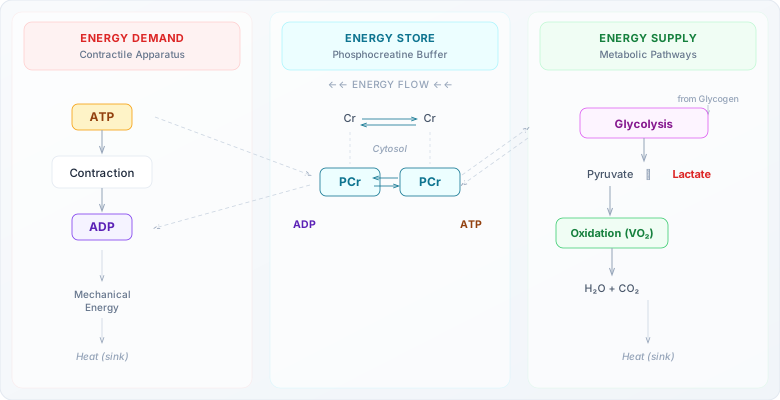
Three parallel ATP sources power skeletal muscle: oxidative phosphorylation, anaerobic glycolysis, and PCr hydrolysis via creatine kinase. PCr acts as a temporal buffer — it covers the instantaneous deficit when aerobic + glycolytic ATP production cannot yet meet demand (Mader 2003; Heck et al. 2022).
Model Theory & Equations
Oxidative Phosphorylation
Aerobic ATP via mitochondria. Driven by [ADP] (Hill n=2). Slow onset (τ=10s), high capacity.
Anaerobic Glycolysis
ATP from glycogen via PFK. Activated by [ADP], inhibited by [H⁺].
PCr / Lohmann Reaction (Creatine Kinase)
Near-instantaneous ATP from PCr via CK (Keq≈166). Finite store (≈20 mmol/kg).
 © 2026 MetaboliSim Origin contributors ·